
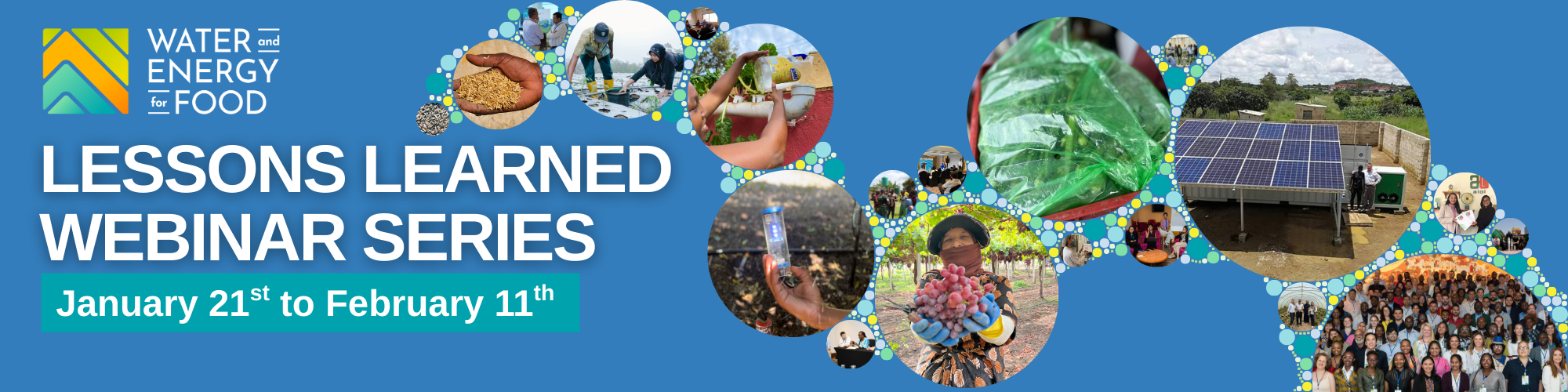
The Water and Energy for Food Grand Challenge kindly invites you to join our Lessons Learned Webinar Series. Running from January 21st to February 11th, this series explores key challenges, successes, and recommendations for cross-cutting themes that can help organizations scale climate innovations while achieving inclusive results.
Mobilization of Private Capital in a Dynamic and Diverse Context
Date and time: January 21st at 7am EST
Globally, WE4F-supported innovators mobilized $211 million USD in five years. From Lebanon to South Africa, Nigeria to Vietnam, the mobilization of private capital helped innovators expand their operations, reaching more smallholder farmers while reducing water consumption and increasing clean energy use in agriculture. In a field known for more for longer timelines and intensive due diligence requirements, how were program staff and innovators able to work together to unlock capital that has been historically difficult to access in some of program-supported countries and for a sector that many investors find to be high risk?
Best Practices on Gender Integration within Challenge Funds
Date and time: January 28th at 8am EST
A key mandate of Water and Energy for Food was the integration of gender mainstreaming in hub and innovators’ business activities to support women smallholder farmers and other end-users, women employees, and women-led and/or -owned innovations. What technical assistance instances and capacity building activities helped innovators improve their collaboration with women? How did hub experts customize offerings to meet the unique needs of women-led and/or -owned innovations in different cultural environments?
End-user Financing as a Key Driver for Innovation Adoption for Base of the Pyramid End-users
Date and time: February 4th at 8am EST
Smallholder farmers and other end-users at the base of the pyramid are the most affected by climate change, with lives, livelihoods, and food security at risk. Innovative water-energy-food solutions, whether technologies, access to agri-inputs, or advisory services, have the potential to help smallholder farmers mitigate the effects of climate change by unlocking productivity, increasing clean energy use, and developing efficient water management practices. The cost of aforementioned innovations prevents many end-users from adopting the innovations, but through the use of end-user financing, affordability barriers could disappear.
Innovator Peer-to-Peer Learning as a Key Tool for Capacity Building and New Business Partnerships
Date and time: February 11th at 8am EST
When innovators exchange knowledge and ideas at capacity building events, they form relationships that can turn into partnerships for new business opportunities. How do organizations, as well as programs, build a framework and culture that enables peer-to-peer learning to produce positive knowledge and partnership outcomes?
