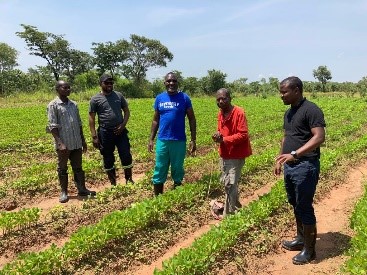
Business and agronomic advisory
Innovation Type:
Water-Energy-Food
Product Segment:
Other
Country of Incorporation:
Zambia
Country of Implementation:
Zambia
Company Stage:
Stage 4: 10,001 to 999,999 end-users
Seeking Investment:
Yes, $700,000 USD
Financing Goals:
Seeking debt (commercial or DFI)
Seeking equity (angel investor, venture capital or private equity)
Contact Name:
Weluzani Joseph Thole
Contact Email:
Website:
Challenges
The impact of climate change has brought about many challenges, with drought and floods being among the biggest threats that Zambia faces. An estimated 2.3 million people in Zambia are on the brink of starvation; food security is threatened by a severe drought caused by dwindling rainfall. Additionally, unpredictable rainfall patterns are expected to worsen with each year..
Farmers’ vulnerability to climate change comes both from being predominantly dependent on rain-fed agriculture and from various socioeconomic, demographic, and policy trends limiting their capacity to adapt to change. Some examples include:
- Taxation on agri-products. Clarity on products that incurred zero tax are not clearly laid out and most farmers do not have access to this information.
- Market dynamics in relation to price. The price of crops like maize, soya and groundnuts are at the ministerial/institutional level, which most times don’t take into account the proper cost to the farmer. This enables black market penetration.
Solutions
Sustainable Builders Zambia focuses on strategies to tackle constraints in the agricultural supply chain that affect smallholder farmers. They improve the functionality of the agricultural supply chain through business management capacity building, upgrading management systems, integrating digital solutions, and improving access to financial products and services for key actors in the agricultural market.
The innovator provides climate-smart agricultural solutions that improve farmers’ livelihoods by increasing harvests’ value and stabilizing the prices of farm inputs and outputs. Their climate-smart agricultural solutions help farmers save water. For example, through digital solutions, they provide weather and agronomic data that advises farmers on optimum water requirements for crops in different climatic regions. Sustainable Builders also partners with microfinance institutions to enable access to finance for women groups.